
N+N 153
Perceptual Capacity

Research
Motivation matters: differing effects of pre-goal and post-goal emotions on attention and memory
“A wealth of research supports the view that people’s goals affect what they remember. Information relevant to a goal that has not yet been achieved remains more accessible in memory than the same information after the goal has been achieved… In part, this occurs because people deliberately prioritize information relevant to active goals, putting more effort into encoding and retrieving it.”
Around the web
“To pay attention, “our thought must be empty, waiting, not seeking anything.” We must be open to “suspending” it, “leaving it detached, empty and ready to be penetrated by the object.” Paying attention means transcending the inner chatter, releasing expectations, and opening ourselves to anything and everything the thing we’re attending to has to offer.” - April Owens (quoting Simone Weil)
“I see the studio must be like a living thing, a life itself. The machine must be live and intelligent. Then I put my mind into the machine and the machine perform reality. Invisible thought waves – you put them into the machine by sending them through the controls and the knobs or you jack it into the jack panel. The jack panel is the brain itself, so you got to patch up the brain and make the brain a living man, that the brain can take what you sending into it and live.” - Lee Scratch Perry
“I like the idea that people are suspended while asking questions about the process, that the viewer might be frozen by wonder.” - Jack Whitten
In the age of digital streaming, how does the Korean pop music industry still profit massively from physical albums?
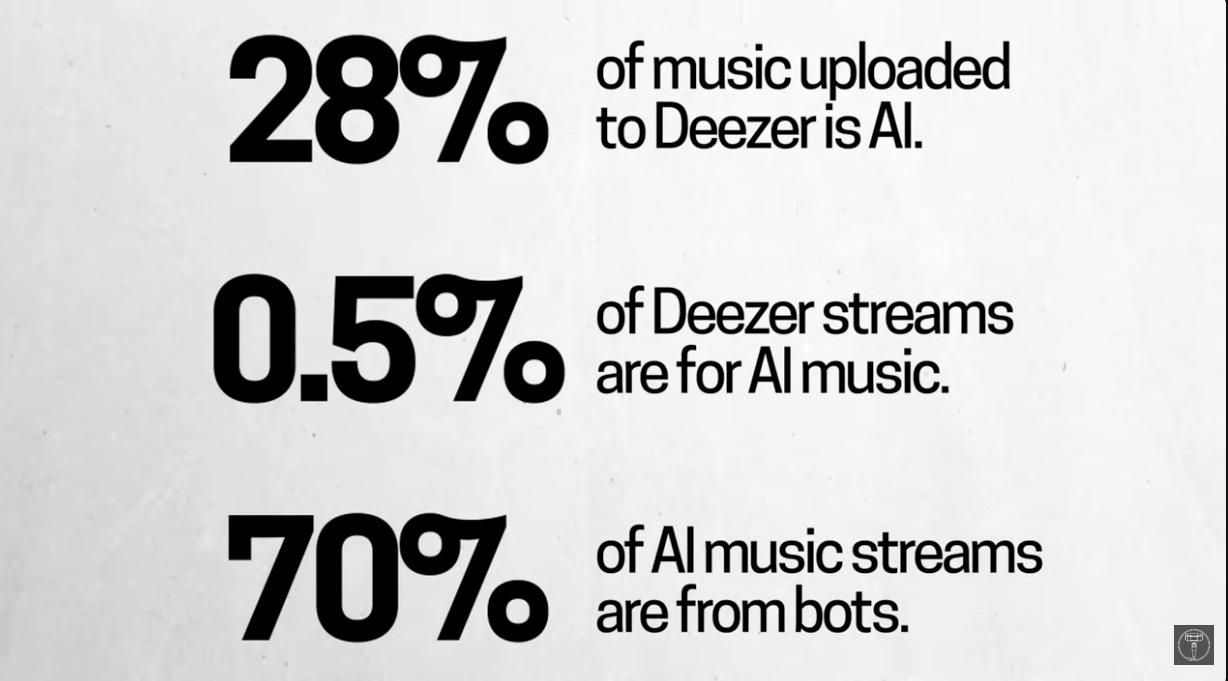
OpenAI is reportedly developing an advanced AI music-generation tool that creates full tracks from text and audio prompts
Opinions on the legal settlement between Universal Music Group and Udio: Good for musicians vs caution
“The success of the AI industry relies on convincing people they’re not capable.” - Mike Monteiro
Listening and watching
Things we’re interested in
“We have been so desensitized by a hundred and fifty years of ceaselessly expanding technical prowess that we think nothing less complex and showy than a computer or a jet bomber deserves to be called “technology” at all. As if linen were the same thing as flax — as if paper, ink, wheels, knives, clocks, chairs, aspirin pills, were natural objects, born with us like our teeth and fingers — as if steel saucepans with copper bottoms and fleece vests spun from recycled glass grew on trees, and we just picked them when they were ripe…” - Ursula K. Le Guin
WETSOUNDS: “is humid, sticky, and alive. The sound of beauty coming undone. A short film meant to be felt more than watched, where sound and image hold equal weight. At its core, WETSOUNDS is about sensation, sound, sight, touch – grounded in the very human experience of sensory overload. Every sound is imminent, oversized, and pushed past the threshold of comfort.”
Game design is simple, actually
Where do game developers get their ideas?
Randomness is programmed out of games
Cling to Blindness, an audio-driven horror game featuring a fully audio-driven design with only simple visual interfaces for controls and menus
“AI needs boundaries, and so do we. The question isn’t just what can this machine do, but what should it serve? And, most importantly, when should we stop?” - Mat Dryhurst
Art “demands that we feel and the think the mystery of our passage through this body, on this earth, in this universe… and bears witness to the bafflement that the mere fact of existence elicits in our brains.” - J.F. Martel
“Does it disappoint me? I don’t know how to quite answer it, other than to say how terrifying this is… No, are you serious? That’s an AI? Good Lord, we’re screwed. That is really, really scary. Come on, agencies, don’t do that. Please stop. Please stop taking away our human connection.” - Emily Blunt (When shown an image of the AI-created Tilly Norwood)
“Current architectures of LLMs cannot imagine, but they can sequence. They can operate within our imaginative symbolic frameworks, but they cannot use symbols because they cannot imagine themselves participating in the negotiation of those symbols. For the same reason that a dog can go to church but a dog cannot be Catholic, an LLM can have a conversation but cannot participate in the conversation.” - Eryk Salvaggio
Research: LLMs can get brain rot from low-quality text and the effects appear to linger
In economics, Jevons’ Paradox illustrates that - contrary to intuition - using a resource more efficiently can actually increase overall consumption of that resource. Technological progress is an example: as productivity rises, our expectations rise in step, if not faster. In turn, this pursuit of ever-greater output gradually compromises our human well-being. We become victims of efficiency. In this context, I find the idea of rest as resistance especially compelling: “In such a world, rest itself becomes an act of rebellion. If AI gives us near-limitless productive capacity, the truly radical act might be to not use it at all. By setting realistic targets for ourselves, and putting up boundaries, we can slow the erosion of our humanity. In itself, saying “enough” might be a kind of innovation. Because, ironically, most research supports the idea that innovation and creativity emerge from reflection not exhaustion. Our best ideas usually come not from being “on” all the time, but from being free enough to ponder and let our minds wander.”
Infinite memory “runs against the very grain of what it means to be human. Cognitive science and evolutionary biology tell us that forgetting isn’t a design flaw, but a survival advantage. Our brains are not built to store everything. They’re built to let go: to blur the past, to misremember just enough to move forward… Selective forgetting helps us prioritize the relevant, discard the outdated, and stay flexible in changing environments. It prevents us from becoming trapped by obsolete patterns or overwhelmed by noise. And it’s not passive decay. Neuroscience shows that forgetting is an active process: the brain regulates what to retrieve and what to suppress, clearing mental space to absorb new information… infinite memory doesn’t just remember our past; it nudges us to repeat it. And while the reinforcement may feel benign, personalized, or even comforting, the history of filter bubbles and echo chambers suggests that this kind of pattern replication rarely leaves room for transformation” - Amy Chivavibul
Largest study of its kind shows AI assistants misrepresent news content 45% of the time – regardless of language or territory
In the UK, Channel 4 deploys Britain’s first AI presenter
“The more I write, the more I realize writing isn’t just a creative act; it’s a mental workout. It’s like lifting weights for your brain. Every session teaches you something about yourself. Your focus. Your patience. Your resistance.
When you write, you see your mind in real time. You see how distracted you are. You see how often you stop to check your phone or re-read a sentence. You see how uncomfortable silence feels.
That’s the beauty of writing. It exposes your inner state.
If your mind is scattered, your writing will be too.
If your thoughts are clear, your words will follow.
That’s why I see writing as a meta skill.
It’s not only about communication. Writing is a practice that gives you many benefits.” - Darius Foroux
From the UK Office for National Statistics, words not to use
Question
What’s the difference between an artist and a creator?
Closing notes
You are reaching the end of the newsletter. Thanks so much for reading!
I hope it’s not been too much of an intrusion and if you liked this issue of the newsletter, please share or recommend to a friend or colleague.
There may be an occasional typo. Woops! There isn’t much I can do once the email has sent, but I do try to correct and update the web version.
Until next week…