
N+N 154
How to hear?

Research
The Evolution of Hearing from Fishes to Homo sapiens - A Chronological Review
Around the web
“Learning music proportionally increases the number of neurons that process it.” - Norman M. Weinberger [Archive link]
Research: A biological rationale for musical consonance
“Certainly this confirms and cements on a much larger scale what we already know about the benefits of music… Specifically, playing an instrument has a particularly big effect, and people who continue to play into an older age saw an additional benefit… Our brain is a muscle like anything else and it needs to be exercised, and learning to read music is a bit like learning a new language, it’s challenging.” - Prof. Anne Corbett
Phones on the dancefloor: “Clubbers are increasingly unable to let go for fear of being recorded, lost in the moment, and DJs are more nervous to experiment outside what they’re known for playing. What was once a space for escape and expression is now another where everyone is being surveilled.”
Beyond The Visual: An exhibition in the UK demonstrating that “blindness is no barrier to creating ambitious, provocative and internationally significant sculpture. Incorporating touch, sound, smell and movement, the works are playful, poetic and often deeply thought-provoking. They challenge the dominance of sight in how we make and experience art, inviting visitors to encounter sculpture in ways that reach far beyond the visual.”
Fear isn’t just what you see – it’s what you hear
Setlist.fm - a free wiki-like service to collect and share set lists. Related: The website reshaping live music, one set list at a time [Archive Link]
17-Year old Morrissey felt The Ramones were “musically incompetent”
The rise and fall of music ringtones
europeana - “We share and promote Europe’s digital cultural heritage to be used and enjoyed by everyone for learning, for work, or just for fun”
Podcast: This is how we built a platform for teaching music
Listening and watching
Things we’re interested in
Finneas on creating a new mnemonic intro for Apple. Here it is. The intro was shot with cameras, lights, and large physical logos. Here’s some behind the scenes footage of the visual composition.
2026 GRAMMY Awards: Best Score Soundtrack for Video Games and Other Interactive Media
Avatar: Frontiers of Pandora - Secrets of the Spires — Pinar Toprak, composer
Helldivers 2 — Wilbert Roget, II, composer
Indiana Jones and the Great Circle — Gordy Haab, composer
Star Wars Outlaws: Wild Card & A Pirate’s Fortune — Cody Matthew Johnson & Wilbert Roget, II, composers
Sword of the Sea — Austin Wintory, composer
Related: Despite being the second-highest-rated new game of the year and a soundtrack receiving critical and commercial success, Clair Obscur: Expedition 33 received no nomination. Austin Wintory, nominated for Sword of the Sea, stated he would “happily trade places” with Lorien Testard, Clair Obscur’s composer.
Land Rover feature a haptic floor in the floor mats of the Range Rover SV Black which vibrate in sync with music. Related: “Aumovio has integrated actuators into a screen unit. The technology makes the surface vibrate, producing sound… The technology can also be used to completely replace traditional speakers in vehicles.”
Spotter - AI video search
Report: State of AI 2025
Implicit trust in AI-generated output represents a serious lapse in critical literacy. In the current landscape, critical evaluation of AI content matters far more than technical proficiency in prompt design.
In disciplines such as medicine, science, and law, professional education is undergoing augmentation rather than automation. The next generation of professionals will need the capacity to work alongside and evaluate AI systems.
The rise of AI is generating an experience bottleneck in professional preparation. Educational systems must evolve to cultivate higher-order, AI-supported competencies prior to workforce entry.
The digital ecosystem is shifting from traditional Search Engine Optimisation (SEO) toward Answer Engine Optimisation (AEO), in which a source’s visibility is determined by its credibility and frequency of citation within AI models.
Governments are acknowledging the importance of regulating content authenticity. Such policies represent a broader institutional commitment to enhancing digital literacy and enabling citizens to discern human from machine.
“If web pages are all read by LLMs, then people ask the LLM for the data and the LLM just produces the result, the whole ad-based business model of the web starts to fall apart.” - Sir Tim Berners-Lee
More from Berners-Lee on AI and local data: “The right place to end up is where you’re totally in control of your data. As the power of local devices becomes greater, then the amount of stuff which gets stored locally increases… a lot of the things that people are building out there on the web are local-first, meaning that they’re designed to be able to work without the cloud. They store data either on the web, or they store the data on your local device. The good place to be is that the data is all stored on your local device. The inference is happening in your device, and you’re in control… I don’t feel that a centralized provider at any level — like content distribution networks or at any level of the web being obviously a centralized monopoly — is good for the web… ”
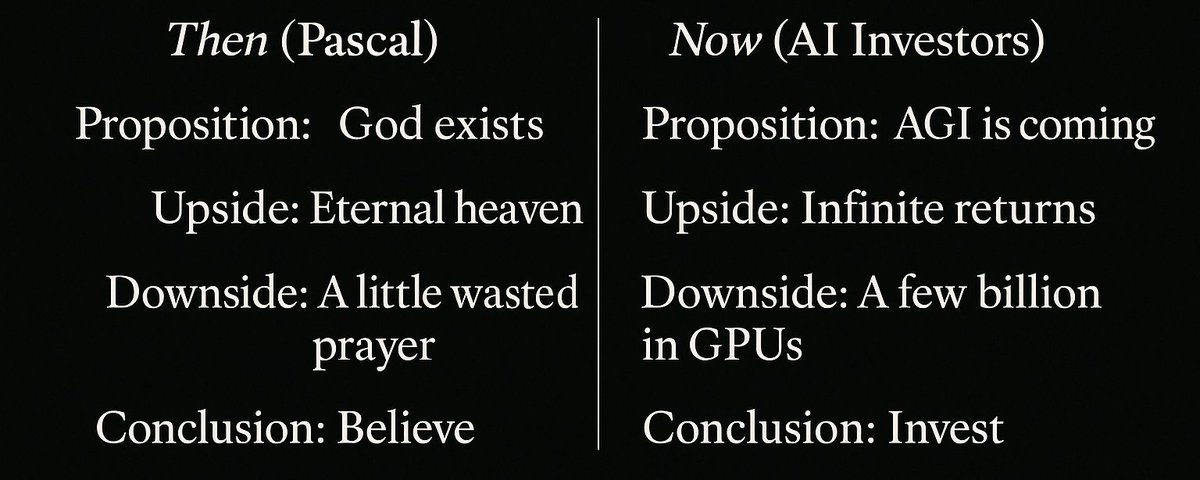
AI: Boom or Bubble - A live, point-in-time dashboard tracking five macro‑to‑micro gauges: capex strain, industry strain, revenue momentum, valuation heat, and funding quality
Question
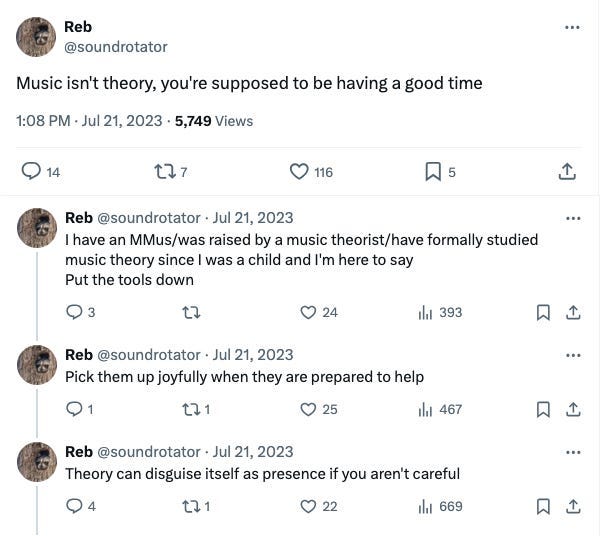
Does music theory improve listening?
Closing notes
You are reaching the end of the newsletter. Thanks so much for reading!
I hope it’s not been too much of an intrusion and if you liked this issue of the newsletter, please share or recommend to a friend or colleague.
There may be an occasional typo. Woops! There isn’t much I can do once the email has sent, but I do try to correct and update the web version.
Until next week…