
N+N 156
Chaos

Research
A Journey into Chaos: Creativity and the Unconscious
Around the web
“Anything you build on a large scale or with intense passion invites chaos.” – Francis Ford Coppola
“Creativity is the ability to tolerate chaos.” - Richard Boyatzis
Useful strategies for dealing with creative anxiety
Stability from chaos: How today’s artists find sustainable success in a turbulent music industry
Musicians losing out on millions due to wrongly allocated UK royalties, new research finds Related: Electronic Music Royalties
“…any explication of music must combine mathematics with aesthetics” - Leonard Bernstein
When a note in a pipe organ gets stuck…
Warner Music settles legal battle with Suno and agrees a partnership
Suno claim to be producing an entire Spotify catalogue every two weeks. Soon, very soon!
Major labels sign licensing deals with AI music company Klay
In the US, a nationally representative survey of 2,244 reveals a love-hate affair with AI music
Listening and watching
Things we’re interested in
“I want you to be madly in love with ideas!” - Ray Bradbury
How the Brussels Sewer Museum leveraged audio guide gamification for high visitor engagement
Sound designer Michael Babcock on using sound to convey character in James Vanderbilt’s Nuremberg: “The cell had to sound like it was made of German cement, but the set itself does not sound like that. I think I had to use every trick I’ve learned in my career to preserve the performances.”
Sound as a fundamental component of audience immersion: “To make a project come to life sonically, you need multiple layers that are made separately and then combined… It’s similar to making a sandwich – it’s not really a sandwich until all the layers are put together… When you’re watching a movie or TV episode, you don’t really think of sound – that’s exactly the point… It’s not supposed to be something you can point out, because in that case, if it’s standing out, it’s really not doing a very good job. It has to be seamless and flow naturally. It’s something that is felt, not heard.”
“Earlier, films used stereo sound; the same system used 20–30 years ago — but now we have Dolby Atmos. In Atmos sound, you are completely immersed; it feels like you are in a sea of sound coming from all directions, and the precise calibration of that sound creates the experience.” - Amala Akkineni
Things that go bump in the night - How sound helps bring horrors to life
Life in Nature is an immersive audio-based survival game with a fully 3D spatial environment
Call of Duty: Black Ops 7 is applying psychoacoustic design to drive tactical decision-making
Podcast: Christopher Larkin Doesn’t Just Score Video Games, He Creates Worlds
Game Awards 2025 - Best Score and Music
Hollow Knight: Silksong
Hades II
Clair Obscur: Expedition 33
Ghost of Yōtei
Death Stranding 2: On the Beach
Sega says AI will make development efficient, but acknowledges “strong resistance” to the tech
AI is “something that’s making everything worse in every single way — I don’t get it… I mean, I get it in a ‘This makes sense to save money by not paying artists’ way.’ But then, what the f#¢k are we doing? Is this where we want to be?” - Rian Johnson
There’s something rather wonderful about this: Poetry circumvents LLM’s safety features
👉 Oliver Burkeman on why he doesn’t use AI to write
Software will really suck in a few years...
Related 1: You may be able to build it, but can you modify/fix it? “I forced myself to use Claude Code exclusively to build a product. Three months. Not a single line of code written by me. I wanted to experience what my clients were considering—100% AI adoption. I needed to know firsthand why that 95% failure rate exists… I got the product launched. It worked. I was proud of what I’d created. Then came the moment that validated every concern in that MIT study: I needed to make a small change and realized I wasn’t confident I could do it. My own product, built under my direction, and I’d lost confidence in my ability to modify it… Now when clients ask me about AI adoption, I can tell them exactly what 100% looks like: it looks like failure. Not immediate failure—that’s the trap. Initial metrics look great. You ship faster. You feel productive. Then three months later, you realize nobody actually understands what you’ve built.”
Related 2: Here’s a piece on the MIT study mentioned.
Related 3: What happens when we’ve developed our dependencies on AI assistance?
“We build our computer systems the way we build our cities—over time, without a plan, on top of ruins.” — Ellen Ullman
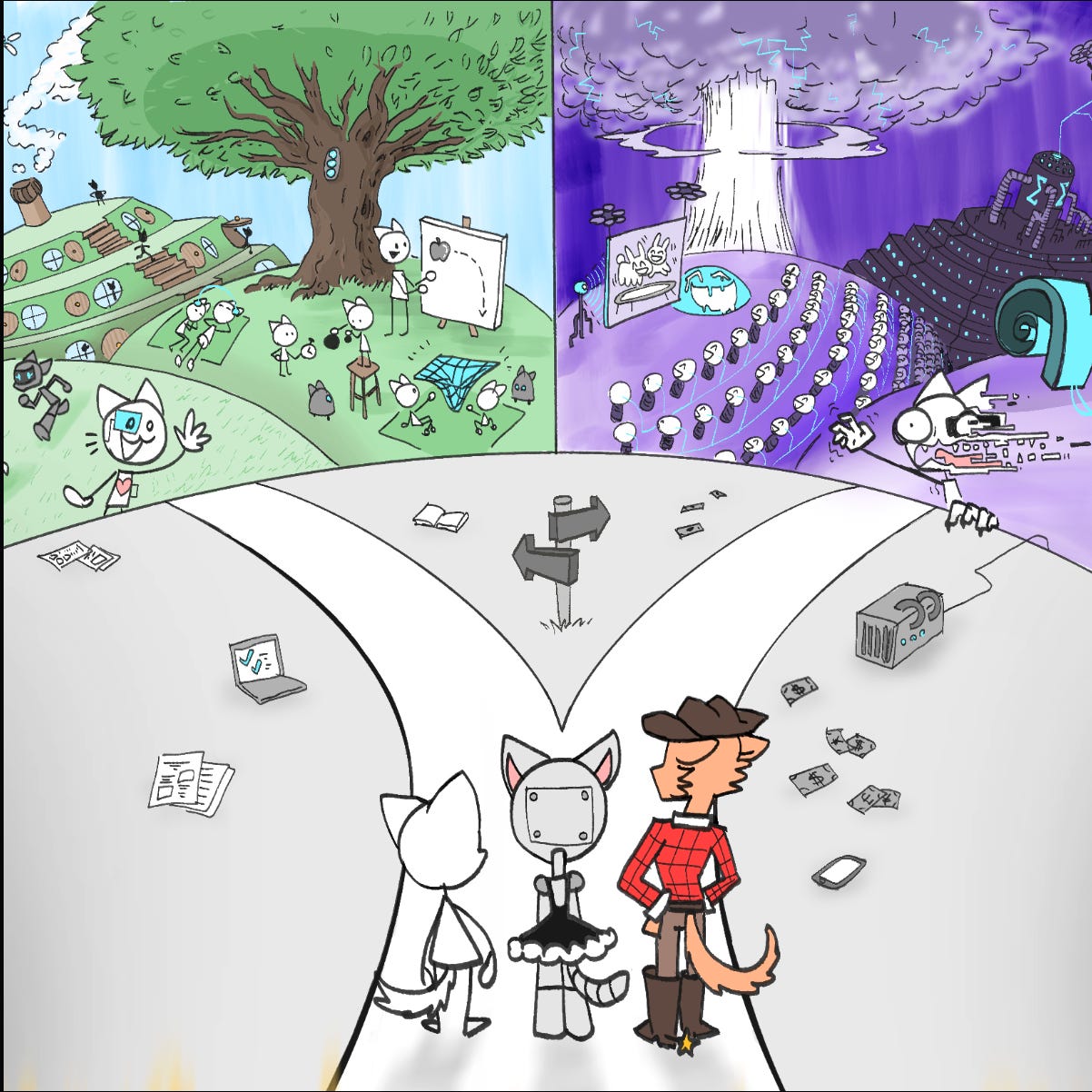
A non-exhaustive collection of worth-reading books on topics strongly related to Critical AI
“One thing that we have learned is that piracy is not a pricing issue. It’s a service issue… The easiest way to stop piracy is not by putting antipiracy technology to work. It’s by giving those people a service that’s better than what they’re receiving from the pirates.” - Gabe Newell
A treasure trove of trend reports for 2026 Here’s a text-based summary and a useful video summary
How to use the internet again: a curriculum - a five-unit crash course in wandering, breaking, and building online
“When life itself seems lunatic, who knows where madness lies? Perhaps to be too practical is madness. To surrender dreams — this may be madness. Too much sanity may be madness — and maddest of all: to see life as it is, and not as it should be!” - Miguel de Cervantes Saavedra, Don Quixote
Question
What are the best/worst platforms for sharing and selling your music?
Closing notes
You are reaching the end of the newsletter. Thanks so much for reading!
I hope it’s not been too much of an intrusion and if you liked this issue of the newsletter, please share or recommend to a friend or colleague.
There may be an occasional typo. Woops! There isn’t much I can do once the email has sent, but I do try to correct and update the web version.
Until next week…